Evaluating any triple insulated wire supplier comes down to four checkpoints — verifiable certification, specification coverage, sampling process, and supply stability. This article walks through each one, explaining how to verify and what counts as a red flag, and uses DAH JIN TECHNOLOGY’s own public records to show what “verifiable” looks like.
When sourcing triple insulated wire (TIW) across borders, what actually determines your risk is not the attractive numbers on a quotation, but four questions you can settle up front: Can the certifications be verified independently? Do the specifications cover your requirements? Is the sampling process clearly defined? Is the supply stable? This article takes the four checkpoints apart one by one — each with a “how to verify” and a “what counts as a red flag” — and applies to evaluating any supplier, ourselves included.
Checkpoint 1: Verifiable Certification
A supplier writing “UL certified” or “complies with UL 2353” is not the same as evidence. The key move is to request the file number and verify it yourself:
- UL product certification: request the file number beginning with E → enter it on UL Product iQ with no login → check the company name, category code OBJT2 and the model range. DAH JIN: E236542 / OBJT2. For an explanation of the UL 2353 standard itself, see What is UL 2353?.
- VDE certification for Europe: ask the supplier for the certificate number and the certified model range. DAH JIN's certificate number is 40008834.
- Be clear what an SGS test report is: SGS issues test reports (for example, RoHS testing per IEC 62321) that prove specific results for the samples submitted. That is different in nature from UL / VDE certification schemes, which combine ongoing factory inspections with an authorised mark — both have value, but they are not interchangeable; a supplier presenting a test report as a certification is a signal worth probing.
Red flags: no file number available, the company name on record does not match the quotation, or the category code has nothing to do with winding wire.
Checkpoint 2: Specification Coverage
Even the cleanest certification is useless if the certified models do not cover your wire gauge range. What to take stock of:
- Thermal class: whether both Class 130(B) and Class 155(F) are offered. DAH JIN’s TLW-B series is Class B at 130°C; TLW-F is Class F at 155°C.
- Conductor size range: whether your core segment is fully covered. DAH JIN’s TLW-B / TLW-BB / TLW-F cover 0.10–1.00 mm; the two-layer TLW-B2 and single-layer TLW-B1 are also available for positions that do not require reinforced insulation.
- High-frequency options: whether a stranded (litz) type is available. DAH JIN’s TLW-B7S is a triple insulated wire with 7 concentrically stranded conductors, built for high-frequency topologies where skin effect is significant.
- Process compatibility: DAH JIN’s TLW series is directly solderable with no need to strip the insulation first, so termination takes fewer steps than with conventional enamelled wire (magnet wire).
Checkpoint 3: Sampling Process
Whether you can run a full validation round at low cost sets the real threshold for switching suppliers:
- Minimum order quantity (MOQ): how to ask — establish the MOQ figure, the unit of measure, and whether special conductor sizes are negotiated separately;for DAH JIN's MOQ, see the FAQ on working with DAH JIN.Red flag: an MOQ so high that the cost of second-source validation becomes uncontrollable.
- Lead time: how to ask — ask the supplier for a concrete lead time at the current shipment volume;for DAH JIN's lead time, see the same FAQ.Red flag: slogans instead of a figure for the current period.
- RFQ information: submit the part number or target specification, conductor size, estimated annual volume and application conditions (working voltage / frequency / temperature rise) through the online RFQ form to receive the specification sheet and sample arrangements.
Checkpoint 4: Supply Stability
- Corporate entity and track record: DAH JIN TECHNOLOGY was established in 2002 (Unified Business Number 80055483, searchable in the Ministry of Economic Affairs business registry) and has been manufacturing winding wire for more than two decades.
- Manufacturing site: our Tainan plant (the manufacturing site stated on the supplement to VDE certificate 40008834); for the UL E236542 factory Follow-Up Service, the UL documents govern.
- Origin: Made in Taiwan, with certificates of origin available.
Four-Checkpoint Quick Reference
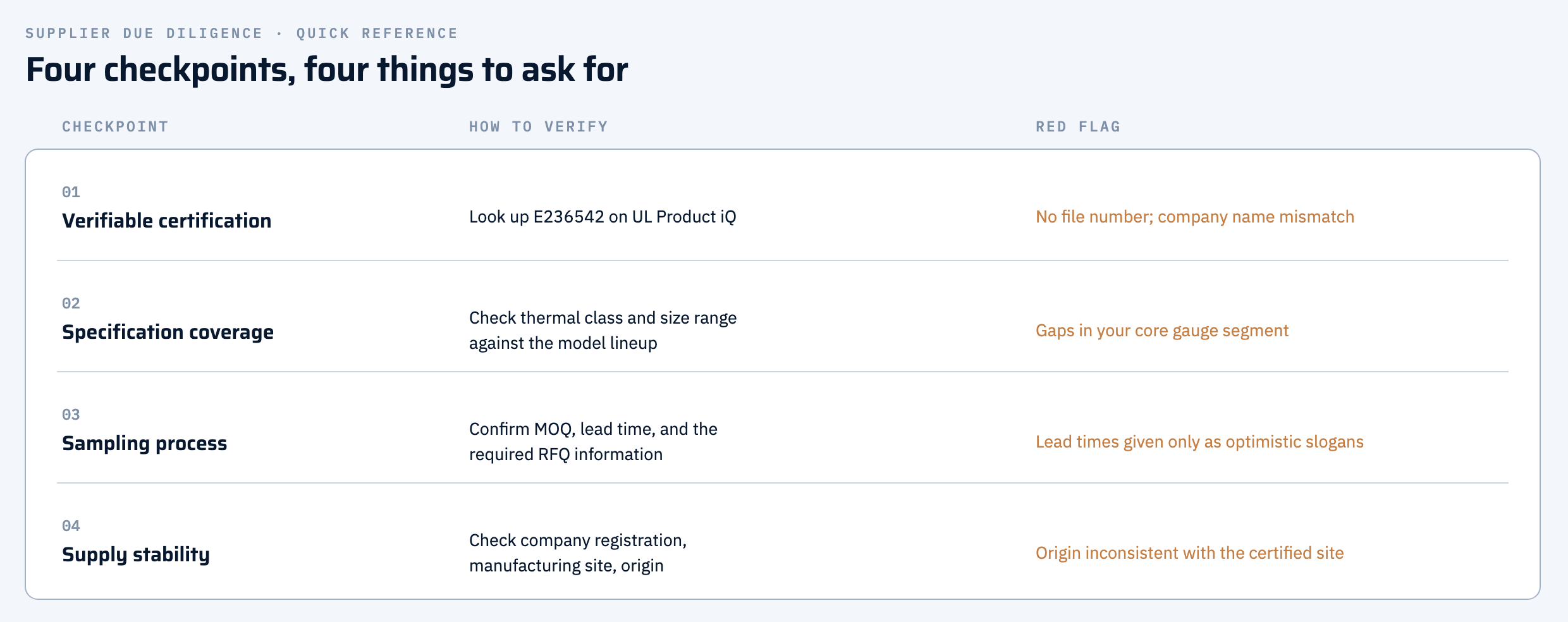
- Verifiable certification — How to verify:Look up E236542 on UL Product iQ;Red flag:No file number; company name mismatch
- Specification coverage — How to verify:Check thermal class and size range against the model lineup;Red flag:Gaps in your core gauge segment
- Sampling process — How to verify:Confirm MOQ, lead time, and required RFQ information;Red flag:Lead times given only as optimistic slogans
- Supply stability — How to verify:Check company registration, manufacturing site, origin;Red flag:Origin inconsistent with the certified site
Frequently Asked Questions
Is UL alone, or VDE alone, enough?
It depends on where you sell. UL E236542 is a component recognition within the UL system (US and Canadian markets); VDE 40008834 certifies against IEC/EN standards (European market). For products exported to both markets, holding both is recommended — and the end product’s safety approval must still be verified against the standards applicable in each sales region.
Does verification cost money or require registration?
No. UL Product iQ is accessible without a login, and the check takes less than five minutes — which is exactly why “verifiable certification” works as zero-cost supplier risk management.
Can an SGS report replace UL/VDE?
No. An SGS report proves specific test results for the samples submitted (RoHS, for example) — it is a test report. UL/VDE are certification schemes that include ongoing factory inspections. They serve different purposes and cannot substitute for each other.
Is a second source really necessary?
Single sourcing is a supply chain risk. Building a second source at an equivalent certification level (UL + VDE) spreads lead time and capacity risk and adds negotiating flexibility — standard purchasing practice in the power supply industry.