Single sourcing is a supply chain risk. This article provides a four-criteria framework for evaluating a second source of triple insulated wire — equivalent certification, specification alignment, controllable validation cost, and supply stability — and explains how to build a backup without replacing your existing supplier.
If your triple insulated wire (TIW) currently comes from a single source, your production line has no second leg to stand on when capacity reallocation, lead-time fluctuation, or logistics risk strikes. The value of a second source lies precisely in building it before you need it. This article offers a pragmatic evaluation framework and explains how to bring DAH JIN TECHNOLOGY on board as a backup — without replacing your existing supplier.
A Second Source ≠ Replacing Your Existing Supplier
Let us clear up a common misconception first: qualifying a second source does not mean replacing the wire you use today.Your existing supplier keeps its position as the primary source;the second source plays the role of insurance — ready to be activated the moment the primary cannot deliver.
The safety role of triple insulated wire is the same either way — forming reinforced insulation between the primary and secondary sides of a transformer.Once certification levels are equivalent and specifications are aligned, component substitution follows the change-management rules of your certification body, which decides whether additional testing is required;DAH JIN provides the UL / VDE certificates and the approval document in support.
The Four Evaluation Criteria
① The certification level must not drop: the second source's certification portfolio must match that of the wire you use today. DAH JIN holds both UL E236542 (category OBJT2) and VDE 40008834 — the same two UL / VDE systems that cover mainstream triple insulated wire on the market; UL Product iQ can be searched without a login. UL E318181, insulation system DJ-130, category "System Components, Electrical Insulation - Component" (OBJS2), Class 130(B) is likewise publicly searchable; customers adopting the DJ-130 insulation system require an Authorization Letter issued by DAH JIN.
② The specifications must align: Mapping by conductor diameter + thermal class + insulation construction is sufficient. DAH JIN covers Class B 130°C (TLW-B, 0.10–1.00 mm), Class F 155°C (TLW-F), a stranded type (TLW-B7S, 7-strand concentric round stranding), and double-/single-layer economy types (TLW-B2/TLW-B1) — the commonly used diameter ranges of mainstream triple insulated wire can be mapped accordingly. This site provides a specification cross-reference tool that maps the three parameters above to DAH JIN part numbers, as a starting point for selection.
③ Validation cost must stay low: An MOQ starting at 1,000 meters and direct solderability (termination steps compatible with your current practice) keep the cost and time of one round of sample validation under control. This is what determines whether a second source can be kept on standby without regret.
④ Supply must be stable: DAH JIN was established in 2002 (Unified Business Number 80055483) and manufactures at our Tainan plant (the manufacturing site stated on the supplement to VDE certificate 40008834), Made in Taiwan — directly compatible with the supply chain policies of export-oriented end products.
A Practical Path Into Your Evaluation
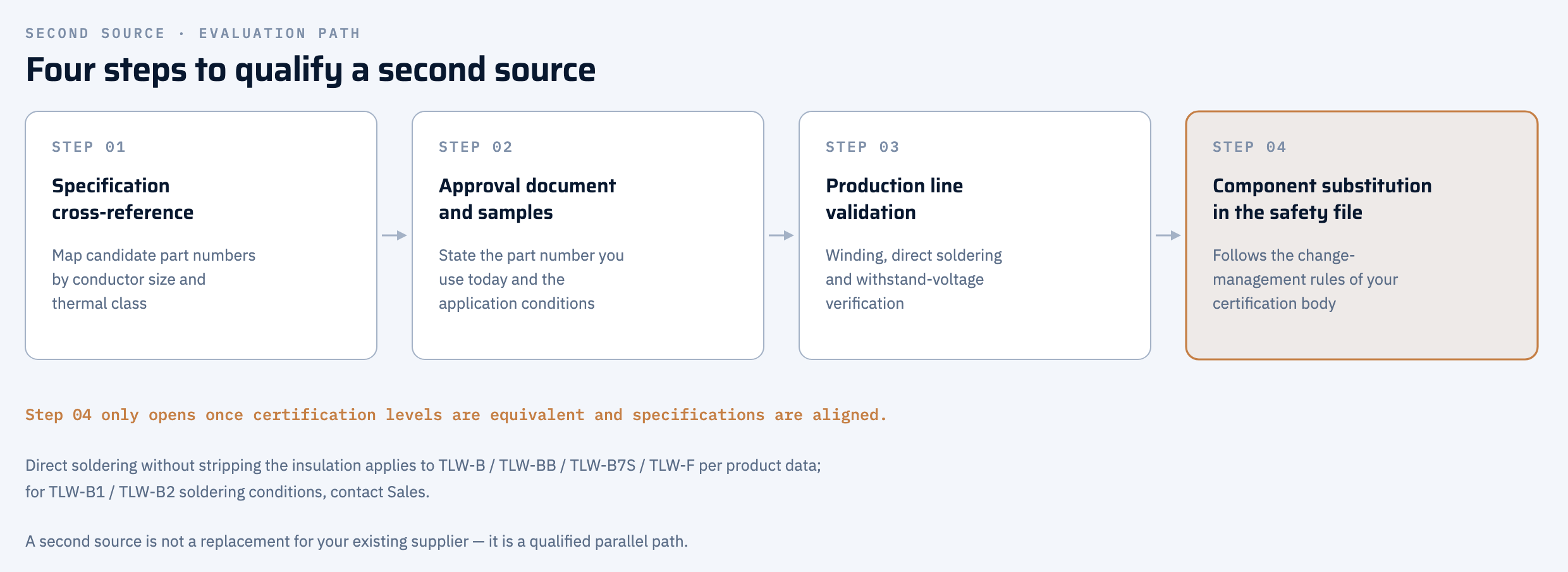
- Specification cross-reference: use this site's cross-reference to map candidate part numbers by conductor size and thermal class.
- Request the approval document and samples: For MOQ and lead time, see the FAQ on working with DAH JIN; when requesting, state the part number currently in use and the application conditions.
- Production line validation: winding, direct soldering, and withstand-voltage verification. TLW-B / TLW-BB / TLW-B7S / TLW-F can be soldered directly without first stripping the insulation (per product data); for the soldering conditions of TLW-B1 / TLW-B2, contact Sales; the process is compatible with your current practice.
- Component substitution in the safety documentation: Once certification levels are equivalent and specifications are aligned, component substitution follows the change-management rules of your certification body, which decides whether additional testing is required; DAH JIN provides the UL / VDE certificates and the approval document in support (see the first question in the FAQ below).
Second-Source Candidate Checklist
- Equivalent certification — What to check:UL + VDE certification held;DAH JIN's answer:E236542 / 40008834 (UL searchable without login)
- Specification alignment — What to check:Diameter, thermal class, construction;DAH JIN's answer:Class B/F, 0.10–1.00 mm, stranded, double/single layer
- Validation cost — What to check:MOQ, process compatibility;DAH JIN's answer:From 1,000 m, direct solderability
- Supply stability — What to check:Track record, origin, site;DAH JIN's answer:Founded 2002, own factory in Tainan, non-China origin
Frequently Asked Questions
Does qualifying DAH JIN as a second source require redoing the end-product safety approval?
This falls within change management. Once certification levels are equivalent and specifications are aligned, component substitution follows the change-management rules of your certification body, which decides whether additional testing is required; DAH JIN provides the UL / VDE certificates and the approval document in support. Any substitution must still be validated by the buyer's engineering team.
Can the specification cross-reference be used directly as the basis for switching?
The cross-reference maps by conductor diameter, thermal class, and insulation construction; it is a starting point for selection, not a guarantee for switching. Before formal adoption, complete winding, soldering, and withstand-voltage validation with samples and the approval document.
Can Class F (155°C) be cross-referenced as well?
Yes — DAH JIN TLW-F (0.10–1.00 mm). Note, however, that the VDE certification scope of TLW-F does not include IEC 61558-1 Annex K. If your product follows the 61558 path and requires Class F, please confirm an alternative with our sales engineers first.
What language is used for technical communication and documents?
Datasheets and certification documents are in English (internationally standard format); technical communication is primarily in English, with Chinese also available. The website offers a multilingual interface and an RFQ form; business correspondence is mainly by email.