TIW selection comes down to three questions: how hot, how thick, how fast. Walk through them in order, with the matching DAH JIN wire types at each step.
Selecting a triple insulated wire really comes down to answering three questions: how hot, how thick, how high-frequency. This guide walks through them in that order, with the corresponding DAH JIN types. (The conductor sizes and specifications in this article are excerpted from the appendix of our approval document; for sizes outside the excerpted range, please contact sales to confirm approval status.)
Question 1: How Hot? — Thermal Class B (130 °C) vs. F (155 °C)
Thermal class is the maximum temperature at which the insulation system may operate continuously. The selection criterion is the actual temperature rise of your transformer in operation, not the ambient temperature:
- Class B, 130°C (TLW-B / TLW-BB): the standard choice for most consumer power supplies, chargers and adapters.
- Class F, 155°C (TLW-F): consider upgrading in three situations — (1) high power density, with temperature rise approaching the Class B limit;(2) high ambient temperature (sealed enclosures, automotive cabin environments);(3) the customer specification explicitly calls for Class F.
An easily overlooked point: the safety certification scope of Class F differs from that of Class B (the VDE scope of TLW-F does not include IEC 61558-1 Annex K) — if your design follows the 61558 path and needs Class F, confirm with your sales contact first (see the safety-path explainer on this site).
Question 2: How Thick? — Conductor Diameter and Current
Conductor size is determined jointly by winding current density and the available winding-window space. DAH JIN's supply range:
- TLW-B / TLW-BB — Construction: triple insulated;conductor size range: 0.10–1.00 mm;thermal class: B 130°C
- TLW-F — Construction: triple insulated;conductor size range: 0.10–1.00 mm;thermal class: F 155°C
- TLW-B2 — Construction: double insulated;conductor size range: per the approval document;thermal class: B 130°C
- TLW-B1 — Construction: single insulated;conductor size range: per the approval document;thermal class: E 120°C
- TLW-B7S — Construction: triple insulated, 7-strand;conductor size range: 7 strands, single strand 0.10–0.30 mm;thermal class: B
For the conductor sizes and thermal ratings of the double-layer and single-layer types, see the approval document;whether they may be mixed with triple insulated wire is determined by the end-product safety approval.
Question 3: How High-Frequency? — Solid Wire vs. Stranded (Litz) Type
As switching frequency rises, skin effect concentrates current in the surface layer of the conductor and the effective cross-section of a thick solid wire falls.Stranded-conductor triple insulated wire (DAH JIN TLW-B7S: 7 enamelled conductors in concentric round stranding, single strand 0.10–0.30 mm;registered under UL E318181 as Litz wire) distributes the current across multiple fine conductors and lowers high-frequency AC impedance — well suited to high-frequency topologies such as LLC and quasi-resonant flyback.The moment you start considering two thinner wires in parallel because of high-frequency losses is the moment to evaluate the stranded type.
Selection Quick Reference (Decision Tree)
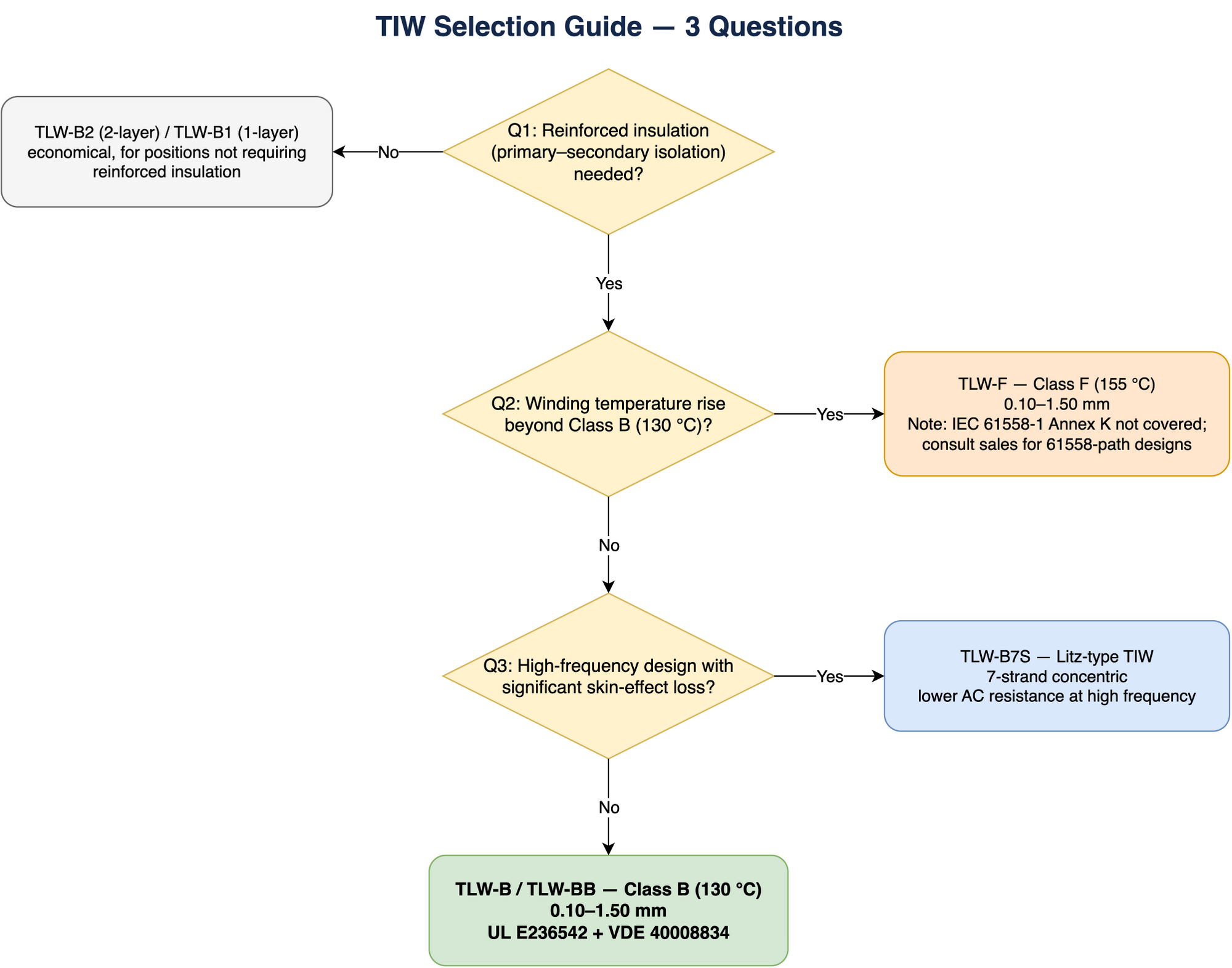
- Need reinforced insulation between primary and secondary?
- ├ No → TLW-B2 (double layer) or TLW-B1 (single layer)
- └ Yes → Will temperature rise exceed the 130°C rating?
- ├ No → Are high-frequency skin-effect losses significant?
- │ ├ No → TLW-B / TLW-BB
- │ └ Yes → TLW-B7S (stranded type)
- └ Yes → TLW-F (the VDE 40008834 evaluation of TLW-F does not include IEC 61558-1 Annex K;for the 61558 path, switch to TLW-B / TLW-BB)
- Medical (IEC 60601-1 Annex L) or adopting the DJ-130 insulation system?→ Yes → TLW-BB / TLW-B7S
Frequently Asked Questions
I am switching from an established brand such as TEX-E — how do the model numbers map?
This site provides a TEX-E cross-reference table (/products/tex-e-cross-reference), mapping DAH JIN types by conductor diameter and thermal class. To start the sample validation process, submit our online RFQ form.
What are the minimum order quantity and lead time?
MOQ is 1,000 m (by length); lead time is 2–8 weeks depending on current shipment volume. Special conductor sizes and packaging are confirmed case by case based on size and quantity.
Can the wire be soldered directly?
TLW-B / TLW-BB / TLW-B7S / TLW-F can be soldered directly without first stripping the insulation (per product data); for the soldering conditions of TLW-B1 / TLW-B2, contact Sales.