The key terms of triple insulated wire, transformer safety insulation, and certification — defined concisely for engineers, quality teams, and buyers.
Insulation Fundamentals
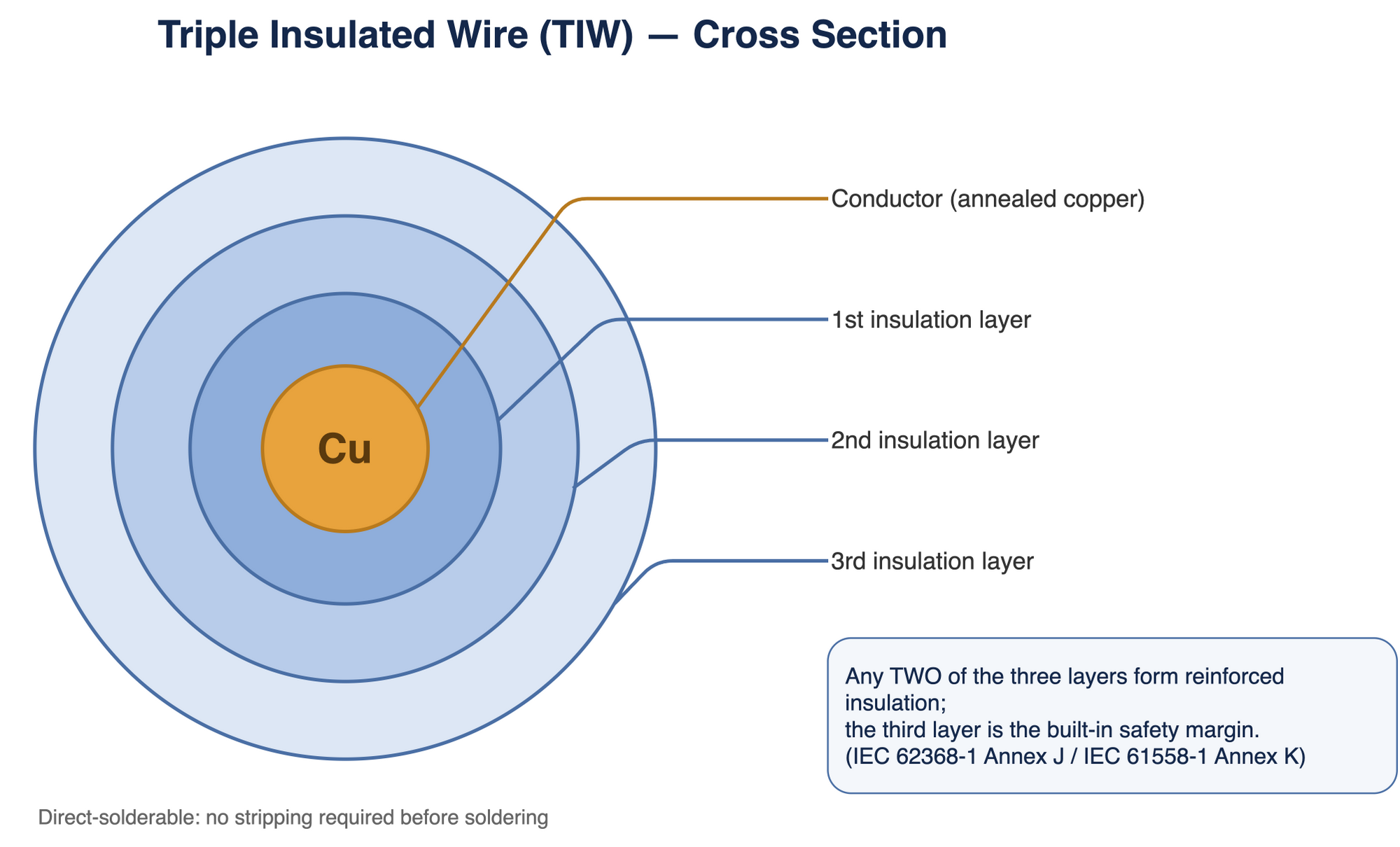
Triple insulated wire (TIW) A winding wire whose conductor is covered with three mutually independent insulation layers; three extruded insulation layers, evaluated under VDE 40008834 per IEC 62368-1 Annex J as reinforced insulation (Reinforced / Extruded / 3 layers), which removes the need for insulating tape and creepage distance design between a transformer's primary and secondary.
Reinforced insulation A single insulation system providing protection equivalent to double insulation; the core safety concept behind primary-to-secondary isolation. TIW meets this requirement with three separable coating layers.
Basic / supplementary insulation Basic insulation is the first line of protection against electric shock; supplementary insulation is the second line in case the basic insulation fails. The two combined constitute double insulation.
Creepage distance / clearance The shortest distance along an insulating surface / the shortest straight-line distance through air. Conventional enamelled-wire transformers must guarantee these with margin tape and edge spacing; using TIW removes this design constraint.
Thermal class The maximum temperature at which an insulation system may operate continuously.Common classes: B = 130°C, F = 155°C.DAH JIN's TLW-B / TLW-BB are Class B;TLW-F is Class F.
Safety Standards and Certification
UL 2353 UL's formal safety standard (Standard for Safety, currently 3rd edition, ANSI-recognized) for single- and multi-layer insulated winding wire. Manufacturers that pass receive an E-prefixed file number (DAH JIN: E236542, category OBJT2), verifiable free of charge on UL Product iQ.
Electrical insulation system (EIS) The combination of insulating materials used in a transformer (under the UL 1446 framework); its system components are registered under UL category OBJS2 (System Components, Electrical Insulation - Component). DAH JIN's DJ-130 system is on file under E318181, Class 130(B); customers adopting the DJ-130 insulation system require an Authorization Letter issued by DAH JIN.
IEC 62368-1 Annex J The annex of the ICT and audio/video equipment safety standard governing "insulated winding wire used as reinforced insulation"; the primary path for chargers and SMPS transformers.
IEC 61558-1 Annex K The corresponding winding wire annex within the transformer safety standard; it and 62368-1 Annex J are two separate tickets (DAH JIN TLW-B and TLW-BB hold both; TLW-F does not include Annex K).
EN/IEC 60601-1 The safety standard for medical electrical equipment; its patient-isolation (MOPP) requirements evaluate winding wire under sub-clause 8.8.2 and normative Annex L (applicable DAH JIN types: TLW-BB and TLW-B7S).
Wire Characteristics and Types
Direct solderability The ability of a wire to be soldered without first stripping its insulation, which reduces termination process steps. TLW-B / TLW-BB / TLW-B7S / TLW-F can be soldered directly without first stripping the insulation (per product data); for the soldering conditions of TLW-B1 / TLW-B2, contact Sales.
Skin effect The phenomenon in which high-frequency current concentrates at the conductor surface, reducing the effective cross-section; it grows with frequency and is the main reason for choosing litz wire and stranded types.
Stranded-conductor triple insulated wire (DAH JIN TLW-B7S: 7 enamelled conductors in concentric round stranding, single strand 0.10–0.30 mm;registered under UL E318181 as Litz wire), used to reduce high-frequency skin-effect losses.
FIW (fully insulated wire) A winding wire whose thickened enamel film is built up in multiple continuous coats using the enamelling process (specified per IEC 60317-56:2017, thermal class 180); usable for reinforced insulation under defined conditions since IEC 62368-1 3rd edition. A different technical route from TIW (see our TIW vs. FIW article).
TEX-E Furukawa Electric's triple insulated wire product family; the industry often communicates specifications using its model numbers. DAH JIN provides a TEX-E cross-reference table (/products/tex-e-cross-reference) for switching and second-source evaluation.
Approval document / specification The formal specification document between manufacturer and customer, stating conductor sizes, tolerances, electrical characteristics, and certification scope. The specification tables on the DAH JIN website are excerpts from the approval document appendix.
RoHS (IEC 62321) The restriction of hazardous substances directive; testing per IEC 62321 produces a test report (DAH JIN's is issued by SGS), which is different in nature from the ongoing certification schemes of UL and VDE.
MOQ (minimum order quantity) The smallest order accepted. DAH JIN's MOQ is 1,000 m (by length); special conductor sizes are negotiated separately.