A complete certification chain for triple insulated wire consists of UL product certification, VDE certification for Europe, an EIS electrical insulation system, and SGS hazardous substance test reports. This article explains the nature of each link and how buyers can verify the UL entries independently through the official database.
When quality assurance and regulatory staff vet a triple insulated wire supplier, the greatest worry is a stack of certificates that looks impressive but never joins up into a complete chain. A certification chain capable of supporting end-product safety approval actually consists of four links, each with its own distinct role — and every link can be verified by the buyer independently. This article walks through them one by one, using DAH JIN TECHNOLOGY's public numbers as a worked example.
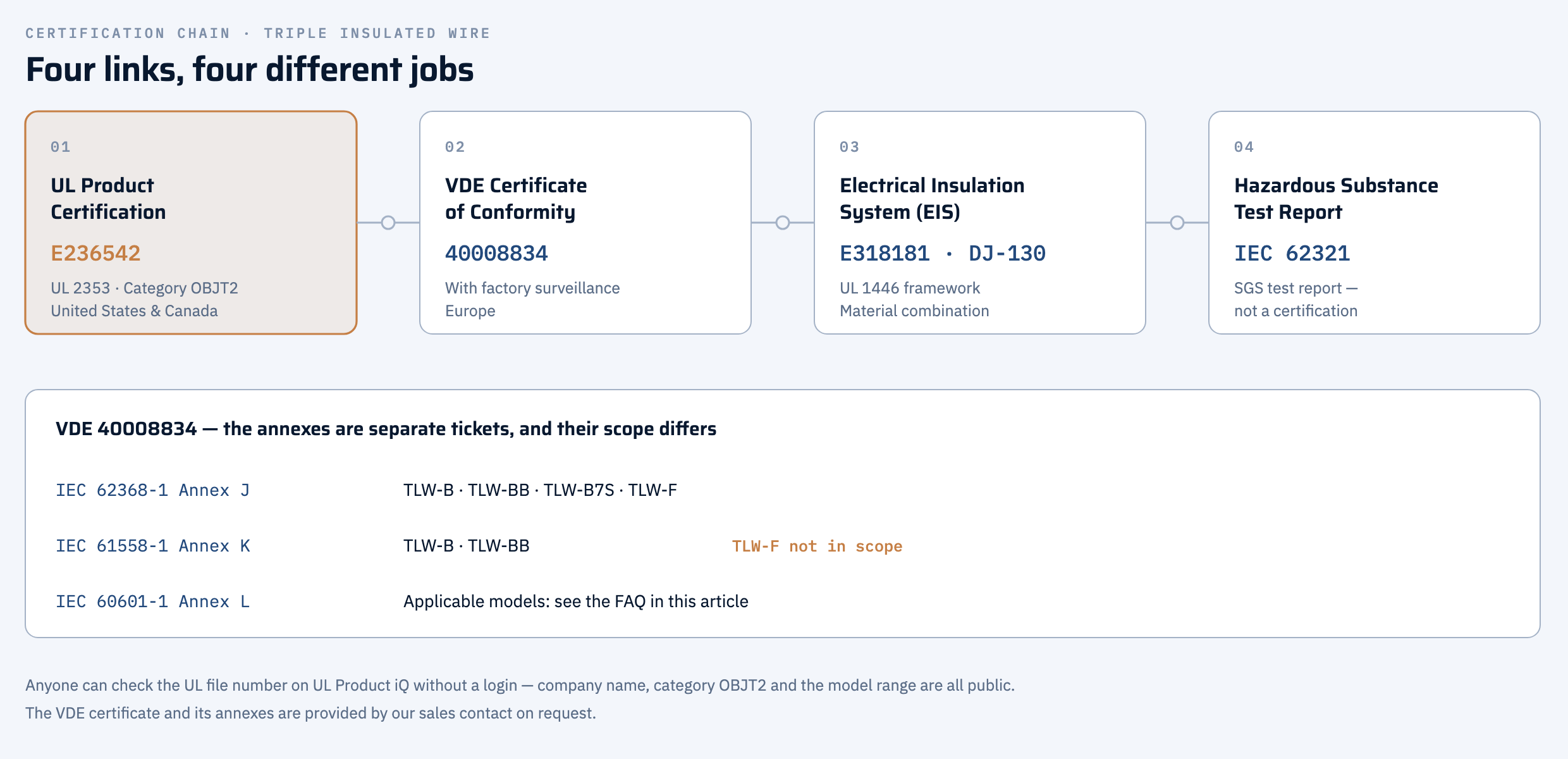
Link 1: UL Product Certification (US and Canada)
UL 2353 is UL's formal safety standard for single- and multi-layer insulated winding wire (Standard for Safety for Single- and Multi-Layer Insulated Winding Wire, currently in its 3rd edition and ANSI-approved). Manufacturers that pass the evaluation receive an E-prefixed file number, and their products are listed under UL category OBJT2 (Single- and Multi-layer Insulated Winding Wire - Component).
- How to verify: on UL Product iQ, enter E236542 without a login and check the company name DAH JIN TECHNOLOGY CO LTD, category OBJT2, and the model range.
Link 2: VDE Certification (Europe)
VDE 40008834 is a Certificate of Conformity with Factory Surveillance, evaluated under IEC 62368-1 Annex J / IEC 61558-1 Annex K / IEC 60601-1 Annex L, and it authorises use of the VDE mark on the listed models. Two of those safety approval paths map as follows (for the models applicable under IEC 60601-1 Annex L, see the FAQ in this article):
- IEC 62368-1 Annex J (normative annex, Insulated winding wires for use without interleaved insulation): the main path for ICT and audio/video equipment power supplies, chargers, and SMPS transformers.
- IEC 61558-1 Annex K (normative annex, Insulated winding wires): the corresponding path for the transformer itself.
The two annexes are two separate tickets — passing one does not automatically mean passing the other. Per the scope stated on DAH JIN's VDE certificate: Annex J applies to TLW-B / TLW-BB / TLW-B7S / TLW-F; Annex K applies only to TLW-B / TLW-BB (TLW-F is not in scope).
Link 3: The EIS Electrical Insulation System
The combination of insulating materials used in a transformer (EIS, Electrical Insulation System, under the UL 1446 framework) is a certification item separate from the winding wire itself; its system components are listed under UL category OBJS2 (System Components, Electrical Insulation - Component).
- DAH JIN's DJ-130 system: file number E318181, Class 130(B), with TLW-BB / TLW-B7S among its constituent components — likewise searchable on Product iQ. Customers adopting the DJ-130 insulation system require an Authorization Letter issued by DAH JIN.
Link 4: SGS Hazardous Substance Test Reports
The nature of this link must be kept distinct: what SGS issues is a test report, not a certification. It attests to specific test results on the submitted sample — RoHS tested per IEC 62321, with REACH (SVHC) available separately — which differs from the UL/VDE certification regime of ongoing factory inspections plus authorized marks. Both have value, but calling a test report an 'SGS certification' is a common misstatement.
Certification Chain Quick Reference
- UL product certification — Number: E236542 (category OBJT2);official verification portal: UL Product iQ, no login;nature: certification (with factory inspections)
- VDE certification (Europe) — Number: 40008834;official verification portal: certificate provided with the RFQ;nature: certification (with factory inspections)
- EIS insulation system — Number: DJ-130 / E318181 (category OBJS2);official verification portal: UL Product iQ, no login;nature: certification (UL 1446 system);customers adopting the DJ-130 insulation system require an Authorization Letter issued by DAH JIN
- SGS hazardous substances — Number: RoHS (IEC 62321) / REACH;official verification portal: report provided with the RFQ;nature: test report (not a certification)
A note on levels: wire certification ≠ end-product certification — triple insulated wire does not itself hold end-product standards such as IEC 61010-1. The role of the wire is to let the transformer achieve the reinforced insulation required by IEC 62368-1 Annex J / IEC 61558-1 Annex K; end-product safety approval is verified on the customer side against the applicable standards. The reverse holds as well: an end product that has passed UL does not necessarily mean the wire has UL — end-product certification and component certification are different levels, and quality assurance should ask the supplier for the UL file number of the winding wire itself and verify it independently, rather than inferring component compliance from an end-product certification.
Frequently Asked Questions
Why should the EIS system be viewed separately from the winding wire?
Winding wire certification (OBJT2) attests to the wire itself; EIS system certification (OBJS2) attests that the wire and the other insulating materials are compatible as a system at a given thermal class. Medical and high-reliability designs often need to cite both.
If the end product passed UL, does that mean the wire has UL too?
Not necessarily. End-product certification and component certification are different levels. QA should require the supplier to provide the winding wire's own UL file number and verify it independently, rather than inferring component compliance from the end-product certification.
Why are you willing to teach customers how to verify?
Because verification only works in favor of compliant manufacturers. Our file number and system number are printed on our website and documents — feel free to verify right now, and apply the same method to every one of your suppliers.